Portfolio
Quantitative Engineer
I have an extensive skillset in Electrodynamics, Computer Science Engineering, PCB Design, Microcontrollers, Testing, and Validation. BS, Engineering Physics w/Focus in Computer Science Engineering. MS, Physics.
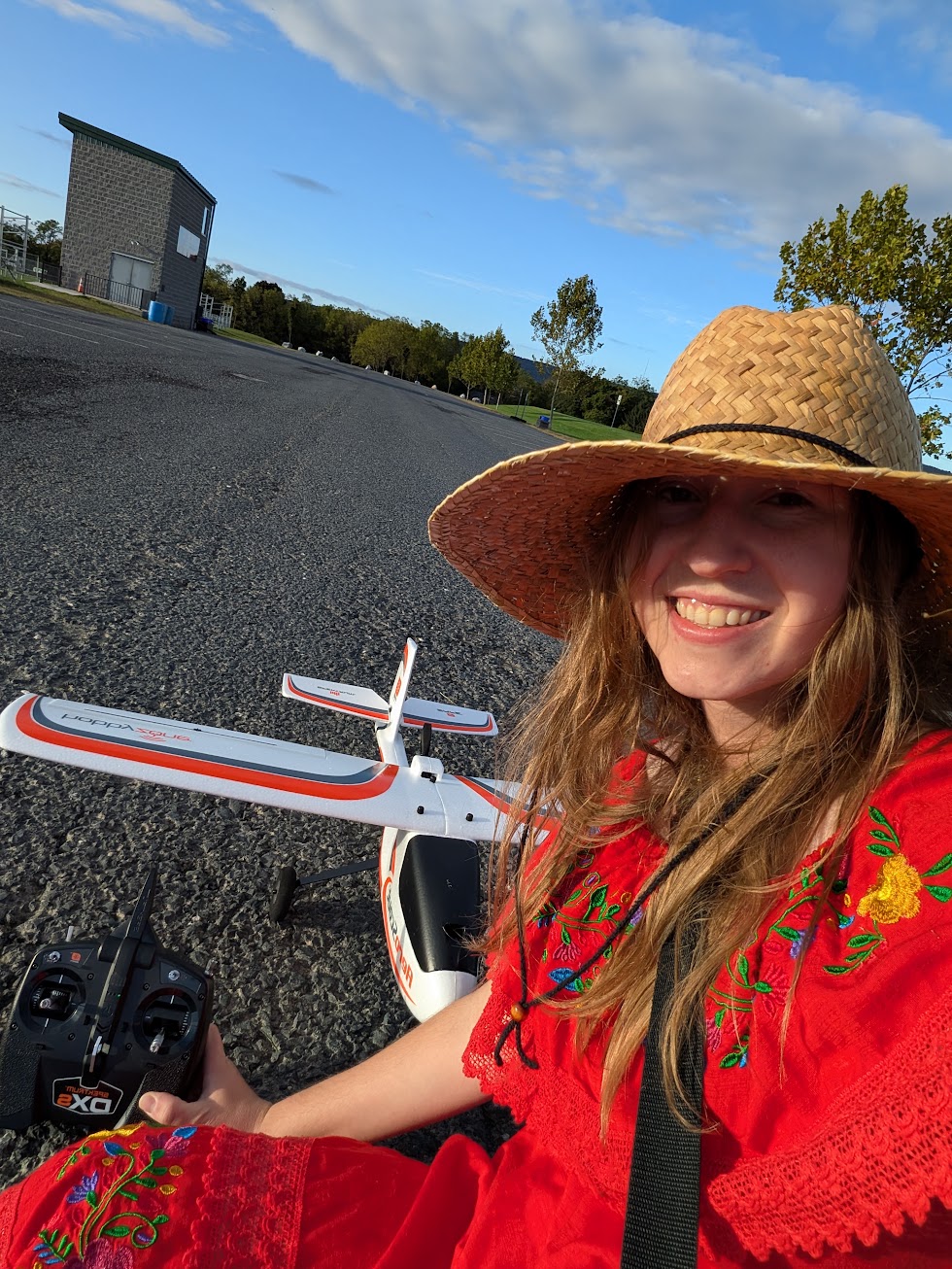
Hardware Prototyping & Electromechanical Design
My background in Engineering Physics bridges the gap between software algorithms and physical hardware. Beyond computational modeling, I actively design, fabricate, and maintain electromechanical systems, driven by a lifelong passion for radio-controlled aviation and analog electronics.
"The Clapp" Analog Synthesizer
Engineered a 12-key, 9V analog synthesizer prototype based on a Clapp oscillator circuit.
- PCB Design: Full schematic capture and board layout executed in KiCad.
- Fabrication: Designed and printed a custom 3D enclosure for physical interface integration.
RC Aviation & Power Systems
Active fixed-wing pilot and maintainer (Horizon Hobby AeroScout). Deep familiarity with RC power ecosystems.
- Airframe Maintenance: Structural repairs using EPO foam adhesives and mechanical linkage rigging.
- Power Delivery: LiPo battery cell management, smart charging diagnostics, and connector soldering.
RF Resonator Arrays
Exploratory design of passive "radio wind chimes" to detect and translate ambient RF signals.
- Theory: LC tank circuit tuning and antenna impedance matching around the 400 MHz band.
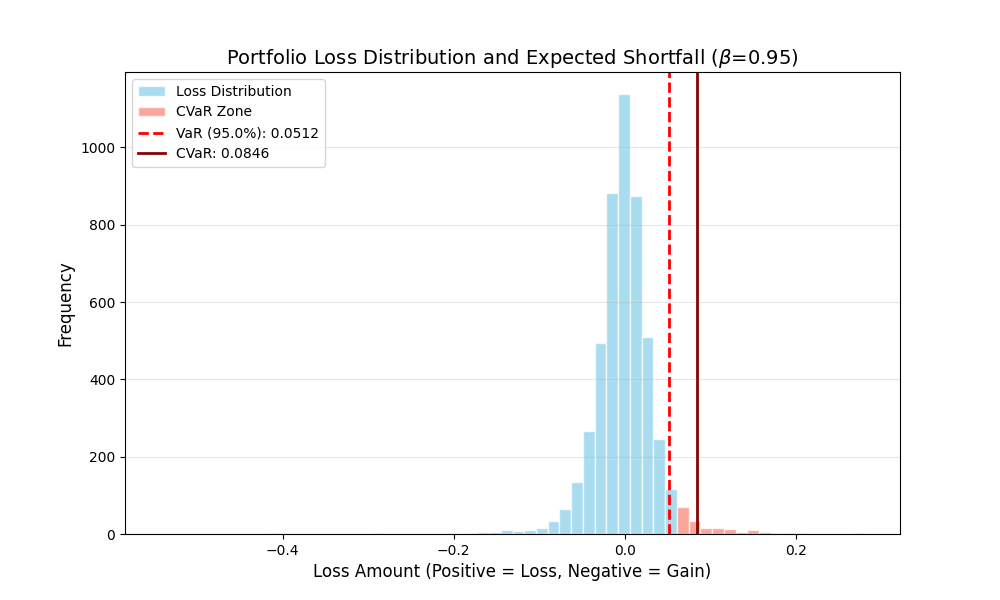
Featured Project: CVaR Optimization: Stochastic Risk Modeling
A reproduction of the Rockafellar & Uryasev framework for simultaneous VaR/CVaR minimization. This implementation replaces standard Gaussian assumptions with Multivariate Student-T distributions to model the "fat-tail" risk inherent in volatile markets.
- Theoretical Foundation: Simultaneous minimization of Equation 9 (Auxiliary Function F_beta) to identify global risk "ground states."
- Tech Stack: Python, SciPy (SLSQP Solver), Matplotlib, Pytest.
- Insight: Demonstrated a significant reduction in tail exposure compared to traditional mean-variance optimization under non-stationary conditions.
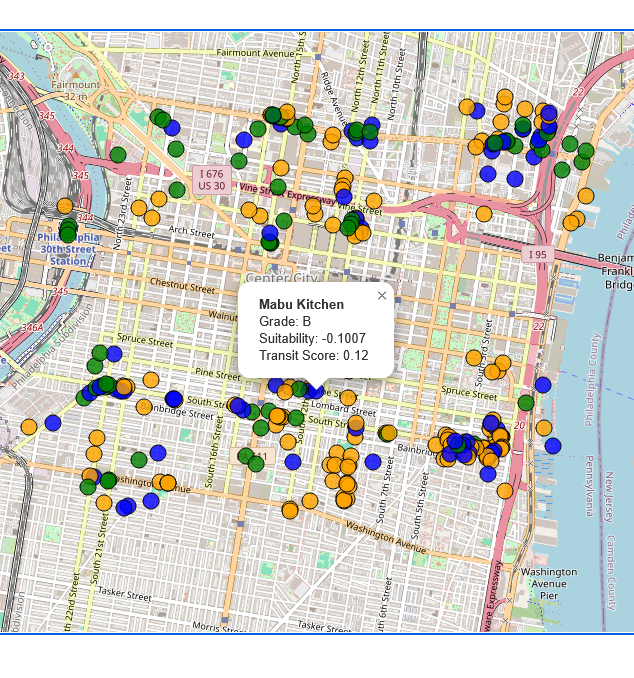
GIS and Data Science Project: Center City Philadelphia Retail Suitability Engine
Leveraging the research methodology I honed in the Sharma Group, I independently parsed current software engineering literature to identify and implement the 11-stage pipeline taxonomy defined in Biswas et al. (ICSE '22). This project demonstrates my ability to bridge the gap between high-impact academic research and production-ready GIS engineering.
The Normalized Suitability Equation:
$$S = 0.7T - 0.3C$$
Where T (Transit) models kinetic foot traffic flow and C (Competition) represents market resistance.
Biswas et al. 11-Stage Data Science Pipeline:
[ACQ] Ingest → [PRP] Prep → [STR] SQLite → [FTA] Feature Analysis → [TRS] Norm → [SLT] Select → [MDL] Model → [EVL] Eval → [INT] Grade → [CMN] Publish → [DPL] Deploy.
Adaptive Spin Evolution: Hilbert Space Expansion in QED

Developed in the Sharma Group at CU Boulder, this project implements an adaptive state space that iteratively expands the Hilbert Space to solve for complex modes (eigenvectors) in strong light-matter coupling scenarios. By utilizing a full Quantum Electrodynamics (QED) treatment, the algorithm identifies critical system dynamics with high precision.
- Technical Features: High-performance matrix calculations and dynamic vector allocation.
- Tech Stack: C++ Back-end, Python Interface (via pybind11), NumPy.
- Insight: Effectively manages the computational overhead of many-body dynamics by focusing state expansion on the most physically relevant regions of the Hilbert Space.
Technical Expertise
Languages & Core Dev
- Primary: Python (Advanced), C++ (High Performance), R, SQL
- Technical/Legacy: FORTRAN, VBA, Assembly x86-64, Bash
- Web & Scripting: PHP, JavaScript, HTML5, CSS3
- Systems: Git/GitHub, Linux (Command Line), SQLite
Frameworks & Tools
- Data Science: NumPy, Pandas, Matplotlib, SciPy, Seaborn
- Machine Learning: PyTorch, TensorFlow, Scikit-learn
- Specialized: pybind11, Unity (VR Development), Boost (C++), LaTeX
- Analytics: Tableau, Google Analytics, GTM, CRMs (Salesforce)
Applied Mathematics
- Modeling: Stochastic Optimization (CVaR), Many-Body Dynamics
- Theory: Probability (Sigma Algebras), Linear Algebra, Asymptotic Analysis
- Geometry: Algebraic Topology, Lie Groups, Lie Algebras
- Physics: QED, Quantum Mechanics, Circuit Simulation (SPICE/KiCad)
STEM Education & Outreach
I am dedicated to making complex scientific concepts accessible through inquiry-based instruction and intentional mentorship.
- Pedagogy & Mentorship: During a year-long involvement with PISEC, I mentored high school students in project-led physics and engineering activities, utilizing research-based pedagogy to foster "science identity" in underrepresented communities.
- Curriculum Development: As a Co-Instructor for CU-Prime (Physics 1400: Foundations of Scientific Inquiry), I bridged the gap between introductory learning and professional scientific practice. By facilitating hands-on exploration across a broad spectrum—including optics, acoustics, quantum mechanics, and relativity—I demystified the scientific process for a diverse student body. I intentionally prioritized minority inclusion and diversity, ensuring the curriculum was accessible and reflected the varied perspectives of the global scientific community.
-
Educational Innovation: Published research: "A Smartphone-Based Virtual Reality Plotting System for STEM Education," International Journal of Mathematical Education in Science and Technology (2021).
DOI: 10.1080/10511970.2021.2006378
Professional Experience
Computational Research & Algorithm Engineering
At Los Alamos National Laboratory, I engineered a high-performance modeling framework that achieved a 9.5x speedup in pattern detection by optimizing the VF2 subgraph isomorphism algorithm. My workflow emphasizes high-performance C++ (Boost) and Python integration.
Technical Note: I actively integrate modern AI-driven development tools, such as Claude Code, to accelerate the transition from mathematical theory to production-ready code, ensuring rigorous testing and optimized numerical performance.
Business Automation & Scalable Data Analytics
As a Business Automation Specialist at Best Companies Group, I developed custom VBA solutions and Excel macros to automate large-scale data operations, significantly reducing manual error rates. Previously, at Discovery Lab Global, I designed an R Studio pipeline to clean and analyze over 500,000 data points, translating complex sentiment data into predictive geographic heat maps.
Academic Mentorship & Technical Lecturing
In my role as a Graduate Research Assistant at the University of Colorado (Sharma Research Group), I developed numerical methods for many-body systems. My professional background is rounded out by extensive experience in technical lecturing and curriculum design, specifically focusing on bridging the gap between introductory STEM education and professional computational practice.